
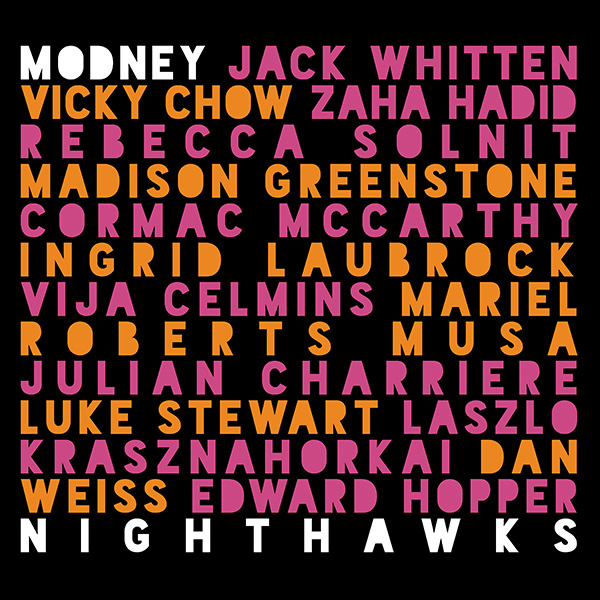
Nighthawks
To be released: February 2027
- Modney – violin, viola
- Ingrid Laubrock – saxophones
- Mariel Roberts – cello
- Dan Weiss – drums
- Madison Greenstone – clarinet
- Vicky Chow – piano
- Luke Stewart – bass
Tracks:
- 1. Jack Whitten
- 2. Zaha Hadid
- 3. Rebecca Solnit
- 4. Cormac McCarthy
- 5. Vija Celmins
- 6. Julian Charriere
- 7. Lazlo Kraznahorkai
- 8. Edward Hopper
Nighthawks
To be released: February 5, 2027
- Modney – violin, viola
- Ingrid Laubrock – saxophones
- Mariel Roberts – cello
- Dan Weiss – drums
- Madison Greenstone – clarinet
- Vicky Chow – piano
- Luke Stewart – bass
Tracks:
- 1. Jack Whitten
- 2. Zaha Hadid
- 3. Rebecca Solnit
- 4. Cormac McCarthy
- 5. Vija Celmins
- 6. Julian Charriere
- 7. Lazlo Kraznahorkai
- 8. Edward Hopper
Produced by David Breskin
Recorded by Ryan Streber at Oktaven Audio, March 14 & 15, 2026
Mixed by Owen Mulholland at Big Sound NYC
Mastered by Eivind Opsvik
Album design and layout by Spottswood Erving and July Creek
for Janky Defense
Nighthawks was made possible thanks to the generous support
of The Shifting Foundation.
Modney’s publishing: Septimal Triad (ASCAP)
© 2027 by Modney and Pyroclastic Records
Thank you to David Breskin for your brilliant mentorship and profound artistic sensibilities, and for your continued belief in… more
Certainly for artists of all stripes, the unknown, the idea or the form or the tale that has not yet arrived, is what must be found. It is the job of artists to open doors and invite in prophesies, the unknown, the unfamiliar; it’s where their work comes from, although its arrival signals the beginning of the long disciplined process of making it their own. Scientists too, as J. Robert Oppenheimer once remarked, “live always at the edge of mystery – the boundary of the unknown.” But they transform the unknown into the known, haul it in like fishermen; artists get you out into that dark sea.
Rebecca Solnit
A Field Guide To Getting Lost
On a fine spring day two years ago, as I descended the grand steps of the Art Institute of Chicago and was greeted by the breezy expanse of Michigan Avenue, a haunting episode from László Krasznahorkai’s Seiobo There Below leapt into my consciousness. I had just spent some hours with Edward Hopper’s famously famous painting “Nighthawks,” a work which had transported me on prior visits. The painting is profoundly quiet yet brimming with subliminal energy, and when I’m near it, I feel as if I’m in the company of an entity that possesses a warmly mysterious presence. It was difficult to tear myself away. Had the museum not been closing for the day, I would have stayed longer. In the chapter “Christo Morto” from Krasznahorkai’s novel, a man travels to Venice for the sole purpose of seeing a painting which had deeply moved him years ago and that he felt compelled to revisit. When he finally arrives and beholds the painting, he is so captivated and spiritually moved that his essence remains there with the artwork in a kind of death. That spring day in Chicago I felt as if my consciousness had split and I experienced a moment of genuine apprehension that part of me had been left behind sitting on the tranquil cool bench in front of the Edward Hopper, and that, like the man in “Christo Morto,” “there would never be any exit from this building, not ever.”
Sometimes I wonder if I’ll rejoin that fragment of myself the next time I go to spend time with the Hopper. Now that the strange moment of fear has passed and I’ve accepted this possibility —that part of me is still sitting there—I take some comfort in it. A recurring theme in Seiobo There Below is the power of art, artists, and seekers to touch upon the sublime, and the peril inherent to such a pursuit. In a magical-realism reading of “Christo Morto,” the man dies or is bifurcated, his spirit remaining with the painting while his husklike body moves on, empty. In a metaphorical (and more optimistic) reading, we may presume that he goes on living but is significantly and irrevocably changed. As Rebecca Solnit examines from many different angles in A Field Guide To Getting Lost, the change that we seek often requires loss, and “sometimes gaining and losing are more intimately related than we like to think.” According to Solnit, the pursuit of transformative experience requires that we acclimatize to, and even come to savor, the discomfort of cohabiting with the unknown.
I’ve had many experiences that have shown me music’s ability to open up higher realms of existence. These realms are difficult to access and lie somewhere at the confluence of practice, technique, heart, intellect, and audience; a territory opened through a ritual of shared attention. Part of the project of this album is built upon a desire for personal growth: I wanted to develop an appreciation for the ways that visual art, architecture, and literature can open up similar realms, and how these might broaden and enrich my music-centric relationship to creativity. The bigger project of Nighthawks—the album and the eponymous band—is to seek out ecstatic artistic experience alongside a group of musicians who are each engaged with the pursuit of the unknown and the sublime in their own practices. The dedicatees of the pieces on this album—four visual artists, three writers, and an architect—are each in their own way also seekers of the sublime. Their use of striking forms and their search for something that synergistically transcends their medium resonates with many of the attributes I value in music-making.
Some of the things I most appreciate about Jack Whitten’s work are his process-based approach to form and his explicit dedications to musicians he admired, such as Miles Davis and Ornette Coleman. (The titles of the pieces on Nighthawks, in addition to joining a long tradition of dedications in musical composition, are a nod to Whitten’s penchant for titling his works with the names of artists from other fields.) In the paintings Whitten made with his “Developer” (a tool resembling a large handmade rake), he swept it across prepared layers of paint with improvisational vigor, employing a simple process to achieve a transcendent result. This relationship—of careful planning and preparation to spontaneous and passionate execution—is beautifully analogous to musical practice and performance. In my piece “Jack Whitten,” which features Vicky Chow and Dan Weiss in an intricately athletic duo as the rest of the band is gradually introduced, the piano writing is derived from a catalog of hand positions on the violin and cello that combine harmonic and stopped pitches. In the coda of the piece, the process behind the piano solo is revealed while the source material is played by strings and drums alone.
In a sense, the hand positions on the violin and cello are “found objects,” and the piano part is an artistic duplicate of those objects. Vija Celmins calls this “redescription,” or “the process of translating one surface to another” in order to attune one’s focus to a greater whole. In Celmins’ works such as “To Fix the Image in Memory I-XI” and “Two Stones,” found objects (stones) are paired with identical-looking replicas that Celmins painstakingly fabricated and painted. These works are impressive technical achievements and an invitation to appreciate the cosmic multitude of differences that exist between objects that are “the same.” In “Vija Celmins” and in many other instances on this album, instrumental “found objects” are paired with “redescriptions” of the same musical material. (I’ll leave it to the listener to decide which is which.) Formally, “Vija Celmins” represents a meditative walk through a gallery of the artist’s iterative Night Sky paintings interspersed with other redescriptive pieces, and an attempt to sonify the tranquil resonance I felt on such a walk with Celmins’ work several years ago.
I have always been drawn to sharp and sometimes startling juxtaposition in the music that I enjoy hearing and the music that I like to make, and I’ve found that the works that resonate with me the most in the broader art world also possess this quality. Cormac McCarthy’s Blood Meridian juxtaposes breathtakingly beautiful descriptions of the natural world with horrific accounts of mankind’s capacity for violence and greed. In McCarthy’s novel, the appallingly immoral Glanton Gang are described as moving on horseback across the unforgiving terrain of the 1850s Mexican-American border “with a single resonance.” The gang’s transcendence of the individual to become some kind of perverse higher being (“a thing that had not been before”) is a dark mirroring of the synergy that we strive for as musicians in search of ecstatic space. In my piece “Cormac McCarthy,” fiddle-music-from-hell chaotically evokes McCarthy’s 19th-century Americana before the band coalesces into a powerfully unified entity that resonates with a terrible consonance.
In several of the works on this album—and in works by those to whom these pieces are dedicated—one element cuts across another, moving with velocity and force across a complex and varied space. “Zaha Hadid” is directly inspired by the architect’s Vitra Fire Station just outside Basel, Switzerland, which is a profound example of “cutting” as a formal idea. The prow of the Fire Station’s ship-like silhouette cuts aggressively across and away from the main structure, which was designed to be irregular and disorienting: a human-made abstraction of nature, akin to the cleverly winding footpaths of Central Park’s “Ramble,” which enable one to become lost in a relatively small area. Unsurprisingly, the semi-surreal, difficult interior of Zaha Hadid’s building made its tenure as a functional firehouse quite brief, but it remains a spectacular place to visit as part of the Vitra Design Museum campus. Like the Vitra Fire Station, the music in “Zaha Hadid” cuts sharply, moving inexorably forward, while tumbling cyclical lines led by Mariel Roberts Musa’s cello keep our ears guessing what’s next.
Julian Charrière often employs classical tropes of balance, symmetry, and beauty to underscore what he’s saying about the present. In his series The Blue Fossil Entropic Stories, images of the artist heroically (or anti-heroically) posed atop an iceberg threatened by global warming echo romanticized depictions of humanity’s relationship to nature from 19th-century painting. This juxtaposition of form and content gives the work an aching immediacy, as the evocation of a nostalgic beauty stands in disconcerting contrast to the subject of climate disaster. In my piece dedicated to Charrière, a flinty duo for violin and drums creates a sparsely organic space for a pristine chorale to cut across, which different soloists then improvise over (Mariel Roberts Musa, Ingrid Laubrock, Luke Stewart). The lamento motif of the chorale then becomes a poignant “Renaissance” tune in 13-limit Just Intonation. These specifically-tuned sonorities hover outside the norms of western harmony, familiar yet strange, and the expected resolution to a simple consonance is withheld until the final chord.
László Krasznahorkai has a special way of tapping into elemental forces through long, winding sentences, and of finding the sublime through narratives that seem bleak on the surface but resonate with overtones of universality. As in Samuel Beckett, the darkness and the light are held in perfect tension. “László Krasznahorkai” features Madison Greenstone’s contrabass clarinet multiphonics with distorted Just Intonation violin. Together we create a fused monolithic chord progression for the band to play over. The piece is a tribute to the final chapter of Seiobo There Below, “Screaming Beneath the Earth.”
While some of the pieces on Nighthawks are responses to specific works of art, others are not. I’ve detailed some of these references here, while others I’ve chosen to omit or have only mentioned tangentially. I hope that the dedications these pieces carry will offer the listener a path into the music and provide novel ways of hearing, while leaving plenty of room for interpretation.
As for “Edward Hopper”: There is a diner on a dark quiet street. The people inside are quiet too, yet the tumult of their hearts is palpable. There is comforting warmth here that belies a terrible beauty just beyond. Gentle clink of dishes, pulse of light. What else can we hear?
Modney
July 22nd, 2026
Brooklyn